Salesforce is the name most people think of first when they hear the word CRM. It is powerful, it has been around forever, and it can pretty much do anything you throw at it. But that power comes at a cost, literally. Between licensing fees, the need for trained developers, and add ons that quietly pile up on your bill, a lot of businesses start wondering if there is a simpler, cheaper, or just better fit for what they actually need.
The good news is you have options. Some businesses want to move away from Salesforce entirely and use a different CRM altogether. Others love their Salesforce setup but want a better way to let customers or partners interact with it, without paying Experience Cloud prices. So this list covers both kinds of alternatives, full CRM replacements and smarter portal solutions that work alongside Salesforce.
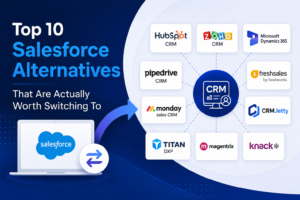
Here are ten Salesforce Alternatives that are genuinely worth a look.
HubSpot CRM
HubSpot is probably the most talked about Salesforce alternative out there, and for good reason. It offers a free tier that is actually usable, not just a stripped down demo, and the paid plans scale up nicely as your team grows. The interface feels a lot less intimidating than Salesforce, which makes onboarding new team members much faster. It is a strong pick for marketing and sales teams that want everything, email, pipelines, reporting, in one place without a steep learning curve.
Zoho CRM
Zoho has built a name for itself by offering an enormous amount of functionality at a fraction of Salesforce’s cost. It covers sales automation, analytics, and workflow management, and it plays nicely with the rest of the Zoho suite if you are already using their other tools. For small and mid sized businesses that want enterprise style features without an enterprise style price tag, Zoho is hard to beat.
Microsoft Dynamics 365
If your company already lives inside the Microsoft ecosystem, Dynamics 365 makes a lot of sense. It connects smoothly with Outlook, Teams, and Excel, so your sales and support teams are not constantly switching between apps. It is a more serious enterprise tool, similar in scale to Salesforce, but many businesses find the integration with tools they already use every day makes the transition worth it.
Pipedrive
Pipedrive was built with one goal in mind, helping sales teams manage their pipeline without extra clutter. It is visual, simple, and does not try to be everything for everyone. If your team finds Salesforce overwhelming and just wants a clean way to track deals and follow ups, Pipedrive is one of the easiest transitions you can make.
Freshsales by Freshworks
Freshsales brings built in phone and email tracking along with AI powered lead scoring, all wrapped in an interface that does not require a manual to figure out. It is a solid option for growing teams that want smart automation without needing a dedicated admin just to keep the system running.
monday sales CRM
monday.com expanded into CRM territory and brought its signature visual, flexible style with it. Teams that already use monday for project management often adopt the sales CRM because everything lives in one connected workspace. It is highly customizable, which makes it appealing to businesses with unique workflows that do not fit neatly into a traditional CRM structure.
Now, if switching your entire CRM feels like too big a leap, there is another path. A lot of businesses are perfectly happy with Salesforce as their core system but want a better, more affordable way to build customer and partner portals on top of it, instead of paying for Salesforce Experience Cloud. This next group of tools focuses on exactly that.
CRMJetty
CRMJetty specializes in building customer, partner, and vendor portals that connect directly to Salesforce, Dynamics 365, and Business Central. Instead of building a portal from scratch or paying for Experience Cloud licenses, businesses can get a launch-ready, no-code portal up and running in days. It comes with a drag-and-drop builder, flat fee pricing, and integrations with tools like Stripe, DocuSign, and SharePoint. Companies using it have reported things like fewer support tickets and faster partner onboarding, since customers and partners can self serve instead of waiting on your team. For businesses that want Salesforce data but not Salesforce-level portal costs, CRMJetty is worth a serious look.
Titan DXP
Titan DXP is built specifically for Salesforce and offers a strong no code, drag and drop portal builder. It is a great option if you know you want to stay fully inside the Salesforce ecosystem and just need a more flexible way to design portals and forms without writing code. The tradeoff is that it is Salesforce only, so it will not help if you are working with multiple CRMs.
Magentrix
Magentrix focuses heavily on partner relationship management, things like deal registration, partner training, and content sharing. It connects with several CRMs including Salesforce, SAP, Dynamics, and HubSpot, which makes it a good fit for companies that care about partner collaboration and community features as much as basic portal functionality.
Knack
Knack takes a different approach entirely. It is not tied to any single CRM, which gives you full control over how you build your portal or app and which systems you connect it to. That flexibility does come with a bit more setup work, since you will likely need some technical involvement to wire everything up. But for businesses that do not want to be locked into one CRM ecosystem long term, that independence can be a real advantage.
Which one is right for you
There is no single best answer here, it really depends on what problem you are trying to solve. If Salesforce itself feels too expensive or too complex for your team, HubSpot, Zoho, Pipedrive, Freshsales, monday sales CRM, or Dynamics 365 are all solid full replacements depending on your size and existing tools. If you actually like Salesforce and just want a better, more affordable portal experience for your customers or partners, CRMJetty, Titan DXP, Magentrix, and Knack each bring something different to the table depending on whether you need multi CRM flexibility, deep Salesforce integration, or strong partner focused features.
Take the time to think about your budget, how technical your team is, and what you actually need the tool to do day to day. The right fit usually becomes pretty obvious once you know what you are solving for.