
Why Eligibility Checks Are Crucial for Optimizing Urgent Care Billing and Reducing Claim Denials

Urgent Care Billing
Urgent Care Billing

In the fast-paced environment of urgent care, efficient billing and accurate insurance verification are key to maintaining a healthy revenue cycle. With patients walking in for immediate attention, practices must act swiftly to confirm coverage, reduce administrative errors, and avoid delays in reimbursement. This is where Urgent Care Billing Services and the role of eligibility checks become essential. By integrating real-time eligibility verification, practices can enhance financial performance, minimize denials, and improve patient satisfaction.

Understanding the Importance of Eligibility Checks in Urgent Care

What Are Eligibility Checks?

Eligibility checks are the process of verifying a patient’s insurance coverage and benefits before or during the visit. These checks confirm whether a patient has active insurance, what services are covered, deductible information, co-pay details, and any authorization requirements.

Why Eligibility Checks Matter in Urgent Care Settings

Due to the walk-in nature of urgent care, insurance verification often happens at the front desk or in real-time. Missing this step can lead to treating patients who are either ineligible or have limited benefits—ultimately resulting in denied claims and lost revenue.

The Link Between Eligibility Checks and Urgent Care Billing Services

1. Reducing Claim Denials and Rejections

One of the most significant causes of denied claims is incorrect or outdated insurance information. Urgent Care Billing Services that include automated or manual eligibility checks significantly reduce the risk of billing errors.

Key Benefits:

  • Fewer claims denied for coverage issues
  • Accurate use of insurance details like group number, payer ID, and eligibility status
  • Prevention of billing non-covered services

2. Speeding Up the Billing and Reimbursement Process

When eligibility is confirmed in advance, the billing team can submit clean claims faster. This not only speeds up reimbursements but also reduces the need for follow-ups or reworking claims.

Operational Advantages:

  • Faster payment turnaround
  • Streamlined claim submission process
  • Minimal back-and-forth with payers for clarifications

How Eligibility Checks Help the Practice Operate More Efficiently

1. Enhanced Front-Office Workflow

Real-time eligibility tools allow front-desk staff to verify coverage instantly. This helps staff educate patients about their responsibilities upfront—such as co-pays or out-of-network charges—improving transparency and cash collections.

Front-Desk Improvements:

  • Shorter patient wait times
  • Better patient communication and satisfaction
  • Reduced confusion at the time of payment

2. Improved Revenue Cycle Management (RCM)

Eligibility verification is a critical first step in the revenue cycle. When integrated into urgent care billing services, it ensures that claims are initiated with accurate information from the start.

RCM Enhancements:

  • Accurate billing codes based on covered services
  • Fewer accounts sent to collections
  • Better forecasting and cash flow management

Benefits of Outsourcing Eligibility Checks with Urgent Care Billing Services

1. Access to Dedicated Billing Experts

Third-party billing services are staffed with professionals trained in payer-specific rules, coverage policies, and verification techniques. They use dedicated systems to ensure that eligibility is confirmed accurately and efficiently.

Expertise You Gain:

  • Reduced administrative burden on in-house staff
  • Fewer errors due to manual data entry
  • Constant monitoring of payer changes and requirements

2. Use of Advanced Billing Software and Integration

Most outsourced billing companies use advanced platforms that integrate with EHRs and practice management systems to perform real-time eligibility checks. This results in seamless coordination between front-desk operations and back-end billing.

Technology Benefits:

  • Real-time verification with multiple payers
  • Instant alerts on coverage issues
  • Electronic documentation of eligibility records for compliance

Real-World Impact of Eligibility Checks in Urgent Care

Practices that implement eligibility checks as part of their urgent care billing process often see:

  • Up to 30% reduction in claim denials
  • 20–40% increase in point-of-service collections
  • Significant improvement in billing accuracy and first-pass claim approval rate

These results translate into healthier cash flow and improved operational efficiency.

Conclusion In urgent care settings where time and accuracy are everything, integrating eligibility verification into the billing workflow is no longer optional—it’s essential. By outsourcing to professional Urgent Care Billing Services that include robust eligibility checks, practices can dramatically reduce claim denials, accelerate payments, and deliver a smoother patient experience. Ultimately, eligibility checks help the practice by strengthening the financial backbone and ensuring long-term sustainability.

Maximizing Insurance Reimbursement for Chiropractors with Correct Back Pain ICD-10 Codes

Back Pain ICD-10
Back Pain ICD-10

Accurate medical coding is critical for any healthcare provider seeking timely and full insurance reimbursements—especially in chiropractic care, where services for musculoskeletal conditions like back pain are common. Leveraging professional chiropractic medical billing services and applying the right back pain ICD-10 codes can significantly enhance claim accuracy and revenue recovery.

This article explores how chiropractors can maximize insurance reimbursements by correctly utilizing back pain ICD-10 codes within streamlined billing processes.

1. The Importance of Accurate ICD-10 Coding in Chiropractic Billing

The International Classification of Diseases, Tenth Revision (ICD-10) is used by insurers to determine the necessity of procedures. In chiropractic billing, coding inaccuracies can lead to claim denials, payment delays, or compliance risks.

Key Points:

  • Back pain is among the top reasons patients seek chiropractic care.
  • Insurers require specific and justifiable ICD-10 codes to process claims.
  • Incorrect or vague codes may result in claim denials or underpayments.

💡 Accurate use of back pain ICD-10 codes helps chiropractic practices communicate medical necessity and avoid revenue loss.

2. Common ICD-10 Codes for Back Pain in Chiropractic Care

There are multiple ICD-10 codes associated with back pain, each addressing different regions and causes. Proper use ensures that the diagnosis aligns with the treatment provided.

Examples of Common Back Pain ICD-10 Codes:

  • M54.5 – Low back pain
  • M54.2 – Cervicalgia (neck pain)
  • M54.6 – Pain in thoracic spine
  • M51.2X1 – Lumbago with sciatica, right side
  • M51.2X2 – Lumbago with sciatica, left side

💡 Using the right ICD-10 code improves clarity for payers, supporting full and faster reimbursements.

3. How Chiropractic Medical Billing Services Improve Coding Accuracy

Chiropractic practices benefit from outsourcing to chiropractic medical billing services, which are equipped with experienced coders, billing software, and payer-specific knowledge.

Benefits Include:

  • Expert coders trained in ICD-10 and CPT coding for chiropractic care.
  • Claim scrubbers that catch errors before submission.
  • Updates on payer guidelines to ensure documentation matches coding.

💡 Billing experts help eliminate guesswork, reducing denials and boosting revenue cycle performance.

4. Ensuring Documentation Supports ICD-10 Coding

Even the correct code can be denied if not supported by thorough documentation. Chiropractic notes must include:

  • Objective findings (e.g., limited range of motion)
  • Pain location and duration
  • Functional limitations
  • Treatment plan justification

💡 Clear documentation backs up ICD-10 coding and validates the medical necessity of care for payers.

5. Avoiding Common Coding Mistakes in Chiropractic Claims

Many reimbursement issues stem from repeat coding errors such as:

  • Using unspecified or outdated codes (e.g., generic “back pain”)
  • Omitting laterality (left vs. right side)
  • Failing to link diagnosis with services rendered

Chiropractic billing services help prevent:

  • Coding mismatches
  • Redundant use of diagnosis codes
  • Inadequate modifier usage

💡 Correcting these errors with professional billing support leads to higher approval rates and fewer reworks.

6. Reimbursement Impact of Proper Back Pain Coding

Insurance companies determine payment based on the accuracy and specificity of the ICD-10 code. By coding precisely:

  • Practices see higher first-pass claim acceptance rates
  • Fewer appeals and resubmissions are needed
  • Reimbursement timelines are shortened

💡 Chiropractors who prioritize accurate back pain coding increase revenue and reduce administrative burdens.

7. Why Chiropractors Should Partner with Billing Experts

Outsourcing to a chiropractic medical billing service allows chiropractors to:

  • Focus on patient care instead of paperwork
  • Stay updated with changing payer and coding regulations
  • Receive monthly reports and performance insights

💡 This partnership ensures a clean billing process from documentation to reimbursement.

Conclusion: A Profitable Approach to Chiropractic Billing

Chiropractic practices that use precise back pain ICD-10 codes and partner with professional chiropractic medical billing services are positioned to maximize reimbursements, reduce denials, and strengthen their financial foundation. Accuracy, efficiency, and compliance go hand in hand when billing is handled by specialists who understand both chiropractic care and insurer expectations.

The Role of a Professional Billing Company in Managing Mental Health and Physical Therapy Claims

The Role of a Professional Billing Company in Managing Mental Health and Physical Therapy Claims

Billing is one of the most important elements of practice finance, especially for specialty areas such as mental health billing services and physical therapy billing services. Both fields have a host of difficult issues when it comes to billing codes, insurance policies, and regulations. The professional billing company can customize the management of such claims to help streamline the revenue cycle so that providers can focus on patient care.

This article discusses the important aspects of professional billing services in managing mental health and physical therapy claims, their advantages, and the processes involved.

Understanding the Complexities of Mental Health and Physical Therapy Billing

Why Is Mental Health Billing Challenging?

Time-based coding, dissimilar insurance coverage of therapy sessions, as well as medical necessity documentation, are all included in unique issues of mental health billing. Besides, this makes claim submissions clearer since the payers have their own requirements for mental health services.

Challenges in Physical Therapy Billing

Billings for physical therapy require strict documentation for timed services, detailed coding of multiple procedures, and adherence to ever-changing payers’ rules. Incorrect coding or lack of documentation can result in denial of claims and loss of revenue.

How a Professional Billing Company Simplifies Mental Health Billing Services

1. Expertise in Mental Health Coding

There are indeed billing corporations which employ well trained professionals possessed of competence in both CPT and ICD-10 coding for Mental Health.

  • Coding of therapy sessions, evaluations and treatments.
  • Comply with the payer requirement for mental health services.

2. Insurance Verification and Pre-Authorization

Insurance verification is done by billing companies for the patient coverages of copayments, deductibles, and pre-authorization requirements, which decrease the chances of claim denial.

3. Managing Denials and Appeals

They can find the billing mistakes or errors swiftly and submit new appeals for denied claims. Professional billing service also works for the time reimbursements. 

4. HIPAA Compliance

Their strict adherence to the HIPAA regulations means that billing companies are capable of keeping most patient health data private through the billing process.

The Role of Billing Services in Physical Therapy Claims

1. Accurate Time-Based Billing

Billing codes associated with temporal aspects are highly common in physical therapy. Professional medical billers guarantee all the documentation processes and the proper coding of services which are less likely to have errors.

2. Streamlined Revenue Cycle Management

The revenue cycle is managed end to end-from patient registration to posting payments-insured through billing companies. They maintain an efficient claim processing along with reduced administrative load.

3. Denial Prevention and Resolution

Professional billing companies have modern software that is capable of flagging various potential errors before a claim submission to drastically lower denial rates. They also follow unpaid or denied claims to get that revenue back.

4. Compliance with Regulatory Changes

The billing firms keep track of the most recent news on regulation changes and the new insurance policy so that they maintain compliance in all their claims for physical therapy.

Benefits of Partnering with a Professional Billing Company

1. Increased Revenue and Cash Flow

  • Effective claim submission and reimbursement would minimize cash flow catch up days. 
  • Improved claim accuracy limits revenue loss through denials underpayments. 

2. Reduced Administrative Burden

  • Outsourcing billing enables the healthcare providers to concentrate on patient care while learning administrative skills. 
  • Workflow streamlining results in overall efficiency improvement.

3. Enhanced Patient Satisfaction

  • Transparent billing can reduce disputes and improve patient trust. 
  • Insurance verification is necessary to make patients aware of their financial responsibilities beforehand.

4. Access to Advanced Technology

  • Professional billing companies use advanced billing soft wares by which accurate claims submission and elaborate financial report generation become possible. 
  • Data analytics enable the practices to track their performance and find revenue opportunities.

Key Features to Look for in a Billing Company

1. Specialization in Mental Health and Physical Therapy

Be deliberate in selecting the best billing firm that has proven the experience in claim management in both mental health and physical therapy practices.

2. Customizable Services

Make sure that the targeted company offers custom-fit solutions that will be specially tailored for the sole needs of your practice.

3. Transparent Pricing

Ensure to look for definite clear-upfront direct costs with none of those hidden charges and surprise costs.

4. Proven Track Record

Investigate the company’s reputation mostly from client testimonials and case studies to determine how well they have fared in managing claims.

Steps to Partner with a Professional Billing Company

1. Assess Your Practice’s Needs

What are the key gaps in your billing process, and what service you’re looking for that matches your needs.

2. Shortlist Billing Companies

Research and compare billing companies that specialize in mental health and physical therapy billing.

3. Discuss Expectations and Goals

Investigate and compare mental health and physical therapy billing companies. 

4. Monitor Progress

Regular review of the performance of the company using in-depth reports and updates to ensure that it aligns with your objectives.

Conclusion

The management of mental health and physical therapy billing services claims can be a daunting task; however, it may be made clear-cut with the help of a professionally qualified billing company. These extremely competent companies specialize in such billing by working on the coding, the verification of the insurance benefits, the tracking of any denial matters for repayment as well as compliance to make that practice’s cash cycle extremely profitable. Outsourcing billing administrate duties gives mental health and physical therapy providers so much more time to care for their patients, helping to reduce administrative burden, increase cash flow, and focus on providing amazing patient care. A solid billing partner means that your billing process will be streamlined, efficient, and compliant, thus ensuring your practice’s financial sustainability.

Prop Firms with TradeLocker: A Game-Changer for Professional Traders?

Prop Firms with TradeLocker

Trends in trading are changing with time and prop trading firms play an important role in this transformation. Prop firms traders must maintain their performance criteria for the continuation of their funded account. In this tough scenario, they need a platform that helps them to improve their skills and get those opportunities that are necessary to increase profits. There is no better choice than a TradeLocker trading platform. This platform is very helpful for prop traders as well as risk-takers and day traders. Let’s see in detail how TradeLocker is a game-changer for professional traders and helps them to increase their profitability. 

What Are Prop Firms and How Do They Operate?

Proprietary trading firms, commonly known as prop firms, provide traders with an amount of capital to start their trading career and in return take a specific percentage of their profit. Traders need to have trading and risk management skills if they want to trade with prop firms for a long period of time. The benefit is that traders do not take risks on their own money so they can trade by focusing on their strategies without worrying about personal losses. To get access to a funded trading account traders first need to complete an evaluation process. These firms not only provide trading capital but also provide learning environments to the traders like training programs that help them to improve their trading strategies. 

TradeLocker Trading Platforms

As best forex prop firms want the traders to perform their best and execute profitable trades these firms provide traders with the best trading platforms that help them to make their trading career more successful. TradeLocker is one of those platforms that is very popular due to its advanced features that simplify the trading process while enhancing performance. This platform can easily integrate with prop trading models that’s why most of the firms prefer it. It provides features:

  • User-friendly interface so traders of all experience levels can easily understand and use it for consistent trading success. 
  • Real-time analytics through which traders can get detailed analytics to analyze market conditions that help them to check their performance and make strategies accordingly. 
  • Risk management tools that help traders to set their risk limits and manage risk more efficiently.

Why TradeLocker Is a Game-Changer for Prop Firms

Enhanced Transparency

Transparency in prop trading is a very important factor and TradeLocker helps to enhance it. This tool provides different real-time performance metrics to help both traders and firms monitor results for more clarity and successful trades. These metrics increase transparency, create platform trust, and bring traders and prop firms into one page.

Customizable Features

TradeLocker also provides customized features for prop firms that want different strategies and goals. It provides different customized interface options and makes it a more preferred choice for different trading styles from scalping to swing trading. Firms can also provide different access levels and resources that match with trader requirements.

Streamlined Evaluation Processes

Prop firms first require traders to complete an evaluation process before getting access to a funded trading account. This evaluation process gets more simplified with the help of radeLocker which has built-in performance tracking and automated reporting. These features reduce the overall administrative overhead for firms and provide a simple onboarding experience for traders.

Risk Management

Risk management is a factor on which the trading success of traders depends. That’s why TradeLocker provides traders with advanced tools to monitor and control risk. They include position-sizing calculators, drawdown limitations, and automated stop-loss options that help traders follow the firm’s strict rules and protect themselves against major losses. 

Support system

TradeLocker’s support team is available 24/7. This team helps traders with any technical issues or strategy optimization. Not only this support Tradelocker is also very cost-effective. Tradeloceker is necessary for traders and prop firms who want a cost-effective platform without sacrificing quality.

How Prop Firms Use TradeLocker to Attract Top Talent

Prop firms always want skilled traders that protect their capital and get maximum returns and they can get those traders by providing Tradelocker trading platforms. Experienced traders who value efficiency and reliability always prefer those firms that provide them with high-performance platforms. Tradelocker helps prop traders to make their funded account challenge more successful. 

Prop firms can use Tradelocker to get strategies including demo accounts that prop firms can provide traders on TradeLocker to showcase the platform’s features. As this tool also promotes advanced analytics, this feature also attracts traders who want data-driven decision-making. TradeLocker’s tools are used by many firms to upskill beginners in their training programs.

Final Thoughts

Tradelocker proved itself as a game-changer for traders and prop firms. It helps traders achieve their goals and make their trading journey with prop firms long-term and successful. As trends in trading change quickly this tool continuously redefines what’s possible to facilitate traders with ease.

Avoiding Common Pitfalls In One-Step Challenge Prop Firm

Avoiding Common Pitfalls In One-Step Challenge Prop Firm

The easiest way to enter the world of trading for a beginner is by showcasing exceptional talent through a step challenge. The one-step challenge is a simple test that assesses the skills of traders and decides whether they can showcase good trade performances on funded accounts. These challenges mainly consist of only a single step, and the trader has to adhere to the rules and regulations set by the proprietary firm.

However, traders must be careful while making trades with the evaluation test. There are common pitfalls that he has to avoid to showcase exceptional performance.

In this article, we shall discuss the common pitfalls associated with the step challenge offered by prop firms and ways the traders can avoid them. 

Understanding The Concept Of One-Step Evaluation

As the name specifies, a one-step evaluation is a trial that consists of only a single step. It is categorized as the profit generation on the demo account provided to the trader by the prop firm while he adheres to the rules and regulations. Deviating from the rules and not following the guidelines can affect the final results negatively. 

Here are some pitfalls to avoid while trying to score well in the one-step challenge by prop firms:

  1. Deviating From The Rules

Now, this is the first and most crucial element of the one-step evaluation. A lot of times, newbie traders get so involved in trading and generating profits on the demo account that they end up deviating from the rules. These rules include maximum drawdown and daily loss limits, along with numerous other points. Some prop trading firms also put restrictions on the usage of certain kinds of strategies or a combination of some strategies. Ignoring this rule is also one reason that may lead to the disqualification of the candidate. 

Hence, it is necessary to stick to the rules strictly. For that, you should go through the list of rules and instructions before jumping to any action. Also, if you find regulations set by some companies extremely strict, you are free to skip them and move to a company that is a lot more generous and provides flexibility. 

  1. Over-leverage Through Quick Actions

Aspiring traders with the spirit to prove themselves to the Best Prop Firms become victims of over-leveraging. Over-leveraging refers to taking actions that make one risk a massive volume of capital on one trade. This means the traders’ shots are enormous and filled with risk. Their motive behind high-value trades is to generate huge profit out of them instantly. However, it can affect the performance of the one-step challenge contender badly. He ends up depleting his demo account of the funds and reaches the loss limits set by the firm a bit too soon. 

To avoid this, aspiring traders must be careful while making trades. It starts by creating a strategy and setting realistic trade plans. Alongside this, monitoring the trades and the results generated by them minutely and keenly helps avoid leveraging. 

  1. Inconsistent Behaviour

Trade results showcasing inconsistent results are also one way of reducing the credibility of an individual as a dependable trader. A lot of times, aspiring traders try to make trades that will help them generate massive profits. They forget that such a thing can’t happen through single trades. This showcase of erratic performance reduces their chances of qualifying for the funded account. Hence, it is always recommended to the new traders to showcase discipline in their actions and only then will they be able to prove their mettle. Their trading actions must showcase some kind of strategy, planning, and consistency. 

  1. Taking Actions Influenced By Emotions

It is generally considered that the newbies in the trading world are not able to hold their emotions. They either get so overwhelmed by a few consistent losses that they end up making extensive, irrational trades to cover up for them, or the few recent successful trades make them overconfident, and they take more actions to maximize profit. Both these kinds of actions are irrational and highly risky. Trades aimed to take revenge or double the profit are both absurd and unreasonable. 

This behavior also showcases the need for more risk management strategies. Diversification of the trades while sticking to the stop-loss orders builds the credibility of a trader and makes him appear dependable for the prop firms.

  1. Using Just One Strategy

Traders need to play in the broader field and showcase versatility. For that matter, they have to utilize varied kinds of strategies and trading plans. As the market conditions change, they should also switch their strategy and shift to others for better performance and profit generation.

Final Thoughts

While chasing the goals set by the One Step Challenge prop firm, traders mostly get lost in the final aim of generating profits. This makes them forget the common pitfalls that may negatively impact their performance. To avoid disqualification from prop firms, it is necessary to showcase good decision-making capabilities and deliver consistent results using diverse strategies. 

Forex Trading for Beginners: Essential Terms You Need to Know

Forex Trading for Beginners

Forex trading is also known as foreign exchange trading. It is the global trading market in which traders from different countries participate. This field of trading is very complex which makes it difficult for beginners to make their trading journey successful. The main reason behind their loss is not having knowledge about the basic information and terms of trading. It is necessary for all traders to know the basic terms of forex trading. So let’s discuss all the essential terms every beginner must know to start their forex journey confidently.

What is Forex Trading?

Forex trading is the global marketplace where traders exchange national currencies. They buy one currency and sell another in the hope of profiting from changes in their relative values. For example, you can buy euros and sell dollars with the intention of selling the euros later at a better price if you believe the euro will rise vs the US dollar. The forex market operates 24 hours a day and five days a week. It allows traders from all over the world to participate and earn profit from this market. It is important to understand the basics of forex trading for beginners whether you are trading for international business, hedging, or speculating.

Key Forex Trading Terms

Currency Pair

Currencies in the forex market are traded in pairs and this is called the currency pairs. Each pair consists of a base currency and a quote currency. For example, In the EUR/USD pair, EUR is the base currency and USD is the quote currency. The price of a currency pair shows how much of the quoted currency is needed to buy one unit of the base currency.

Pip (Percentage in Point)

A pip is the smallest price move in the forex market. It represents a standardized unit of measurement. Most currency pairs are quoted to four decimal places and a pip is typically the fourth decimal place. For example If EUR/USD moves from 1.2000 to 1.2005, it has moved 5 pips.

Spread

The spread is the difference between the bid price which means what a buyer is willing to pay and the ask price which means what a seller is asking for. High liquidity is frequently indicated by a tighter spread, whereas poor liquidity or high volatility can be indicated by a larger spread. 

Forex Market Participants

Retail Traders

Retail traders are those investors who trade forex through brokers. Even though they only make up a small portion of the market they have an important effect on its dynamics.

Institutional Traders

These include banks, hedge funds, and multinational corporations. Institutional traders dominate the forex market and execute trades at a much higher volume than retail traders.

Central Banks

Central banks influence forex markets by setting interest rates and implementing monetary policies. Their decisions can cause currency changes.

Types of Forex Orders

Market Order

A market order is an instruction to buy or sell a currency pair immediately at the current market price. This type of order guarantees execution but it can also cause price slippage during volatile periods.

Limit Order

A limit order sets a specific price level at which you want to buy or sell a currency pair. Unlike market orders, limit orders guarantee price but not execution.

Stop-Loss Order

When the price hits a preset level, a stop-loss order automatically closes a transaction and this helps in reducing losses. For example, if you buy EUR/USD at 1.1000 and set a stop-loss at 1.0950 then the trade will close if the price drops to 1.0950.

Leverage and Margin

Leverage

Leverage allows traders to control a larger position with a smaller amount of capital. For example, a leverage ratio of 50:1 means you can control $50,000 with just $1,000. Leverage raises risk while increasing possible returns. 

Margin

The asset that is required for starting a leveraged position is known as margin. It is stated as a percentage of the overall value of the trade. For example, a 2% margin requirement means you need $2,000 to trade a position worth $100,000.

Risk Management

Lot Sizes

Forex is traded in lots. The most common types are:

  • Standard Lot: 100,000 units of the base currency
  • Mini Lot: 10,000 units
  • Micro Lot: 1,000 units

Risk-Reward Ratio

Possible profit and possible loss are compared in this ratio. If you want to make $2 for every $1 you risk then the ratio is 2:1. 

Forex Trading Strategies

Scalping

Scalping is making small profits from different trades throughout the day. It needs quick decision-making and a strong understanding of market trends.

Day Trading

Day trading includes opening and closing positions within a single trading day. The goal is to capitalize on short-term price movements.

Swing Trading and Copy Trading

Swing trading focuses on capturing price swings over days or weeks. This strategy suits traders who prefer a more relaxed approach. Copy trading helps beginners to copy the trades of experienced traders.

Conclusion

Forex trading is a complex field but also provides opportunities to those who invest their time and resources in learning and understanding all the complexities of the trading market. So it is very important to first learn about the essential terms and strategies that help to create a successful trading journey.

Avoiding Common Pitfalls In One-Step Challenge Prop Firm

Avoiding Common Pitfalls In One-Step Challenge Prop Firm

Avoiding Common Pitfalls In One-Step Challenge Prop Firm

The easiest way to enter the world of trading for a beginner is by showcasing exceptional talent through a step challenge. The one-step challenge is a simple test that assesses the skills of traders and decides whether they can showcase good trade performances on funded accounts. These challenges mainly consist of only a single step, and the trader has to adhere to the rules and regulations set by the proprietary firm.

However, traders must be careful while making trades with the evaluation test. There are common pitfalls that he has to avoid to showcase exceptional performance.

In this article, we shall discuss the common pitfalls associated with the step challenge offered by prop firms and ways the traders can avoid them. 

Understanding The Concept Of One-Step Evaluation

As the name specifies, a one-step evaluation is a trial that consists of only a single step. It is categorized as the profit generation on the demo account provided to the trader by the prop firm while he adheres to the rules and regulations. Deviating from the rules and not following the guidelines can affect the final results negatively. 

Here are some pitfalls to avoid while trying to score well in the one-step challenge by prop firms:

  1. Deviating From The Rules

Now, this is the first and most crucial element of the one-step evaluation. A lot of times, newbie traders get so involved in trading and generating profits on the demo account that they end up deviating from the rules. These rules include maximum drawdown and daily loss limits, along with numerous other points. Some prop trading firms also put restrictions on the usage of certain kinds of strategies or a combination of some strategies. Ignoring this rule is also one reason that may lead to the disqualification of the candidate. 

Hence, it is necessary to stick to the rules strictly. For that, you should go through the list of rules and instructions before jumping to any action. Also, if you find regulations set by some companies extremely strict, you are free to skip them and move to a company that is a lot more generous and provides flexibility. 

  1. Over-leverage Through Quick Actions

Aspiring traders with the spirit to prove themselves to the Best Prop Firms become victims of over-leveraging. Over-leveraging refers to taking actions that make one risk a massive volume of capital on one trade. This means the traders’ shots are enormous and filled with risk. Their motive behind high-value trades is to generate huge profit out of them instantly. However, it can affect the performance of the one-step challenge contender badly. He ends up depleting his demo account of the funds and reaches the loss limits set by the firm a bit too soon. 

To avoid this, aspiring traders must be careful while making trades. It starts by creating a strategy and setting realistic trade plans. Alongside this, monitoring the trades and the results generated by them minutely and keenly helps avoid leveraging. 

  1. Inconsistent Behaviour

Trade results showcasing inconsistent results are also one way of reducing the credibility of an individual as a dependable trader. A lot of times, aspiring traders try to make trades that will help them generate massive profits. They forget that such a thing can’t happen through single trades. This showcase of erratic performance reduces their chances of qualifying for the funded account. Hence, it is always recommended to the new traders to showcase discipline in their actions and only then will they be able to prove their mettle. Their trading actions must showcase some kind of strategy, planning, and consistency. 

  1. Taking Actions Influenced By Emotions

It is generally considered that the newbies in the trading world are not able to hold their emotions. They either get so overwhelmed by a few consistent losses that they end up making extensive, irrational trades to cover up for them, or the few recent successful trades make them overconfident, and they take more actions to maximize profit. Both these kinds of actions are irrational and highly risky. Trades aimed to take revenge or double the profit are both absurd and unreasonable. 

This behavior also showcases the need for more risk management strategies. Diversification of the trades while sticking to the stop-loss orders builds the credibility of a trader and makes him appear dependable for the prop firms.

  1. Using Just One Strategy

Traders need to play in the broader field and showcase versatility. For that matter, they have to utilize varied kinds of strategies and trading plans. As the market conditions change, they should also switch their strategy and shift to others for better performance and profit generation.

Final Thoughts

While chasing the goals set by the One Step Challenge prop firm, traders mostly get lost in the final aim of generating profits. This makes them forget the common pitfalls that may negatively impact their performance. To avoid disqualification from prop firms, it is necessary to showcase good decision-making capabilities and deliver consistent results using diverse strategies.

Top 8 Software Design Principles

Software Design Principles In the ever- evolving geography of software development, clinging to robust software design principles is consummate for creating justifiable, scalable, and effective operations. These principles serve as foundational guidelines that help inventors navigate the complications of software armature, icing that the final product is both functional and sustainable. In this comprehensive companion, we claw into the key software design principles that every inventor should master.

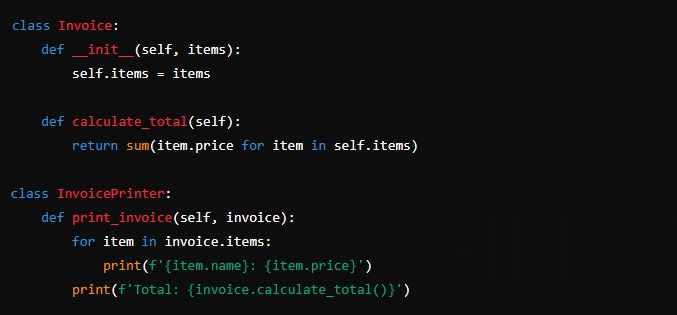
1. Single Responsibility Principle( SRP)

The Single Responsibility Principle dictates that a class or module should have only one reason to change, meaning it should have only one job or responsibility. This principle aims to reduce the complexity and increase the cohesion of the law, making it easier to understand and maintain

Benefits of SRP

Enhanced Readability When a class is responsible for only one task, it becomes easier to understand its purpose and functionality.

Simplified Testing segregating liabilities makes it easier to write unit tests for individual factors. bettered Maintainability Changes in the conditions of one responsibility don’t affect other corridor of the law.

Example

Top 8 Software Design Principles

2. Open/ Closed Principle( OCP)

The Open/ Closed Principle states that software realities( classes, modules, functions ,etc.) should be open for extension but closed for revision. This means you should be suitable to add new functionality without altering being law, therefore reducing the threat of introducing bugs.

Benefits of OCP

Reduced Risk : By not modifying being law, you minimize the chances of introducing new crimes.

Ease of Extension : New features can be added with minimum impact on being functionality. Encapsulation Promotes the use of abstraction to cover the integrity of the codebase.

Example

3. Liskov Substitution Principle( LSP)

The Liskov Substitution Principle asserts that objects of a superclass should be interchangeable with objects of a class without affecting the correctness of the program. This principle ensures that a class can stand in for its superclass.

Benefits of LSP

Predictable Behavior : Sorts can be used interchangeably with their base classes, icing thickness.

Advanced Interoperability : Promotes the use of polymorphism and interfaces. Simplified Codebase Reduces complexity by allowing the use of generalized law. illustration

Example

4. Interface Segregation Principle( ISP)

The Interface Segregation Principle advises that no customer should be forced to depend on styles it doesn’t use. rather of having one large, bloated interface, it’s better to have multiple lower, more specific interfaces.

Benefits of ISP

Enhanced Inflexibility : guests depend only on the interfaces that are applicable to them. bettered Maintainability lower interfaces are easier to understand and modify.

Reduced reliance : lower coupling between classes leads to a further modular codebase. illustration

Example

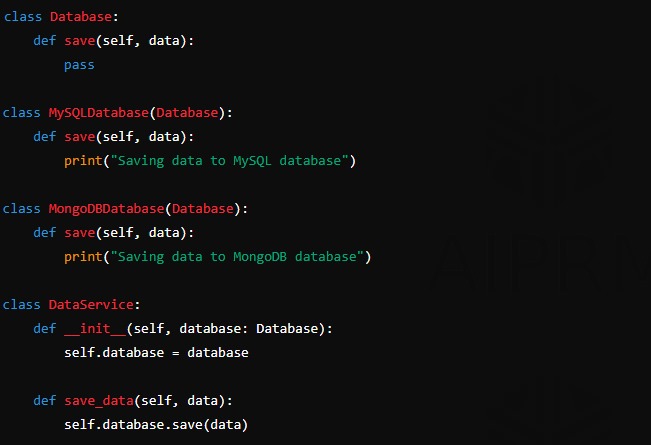
5. reliance Inversion Principle( DIP)

The Dependency Inversion Principle suggests that high- position modules shouldn’t depend on low- position modules. Both should depend on abstractions. also, abstractions shouldn’t depend on details; details should depend on abstractions.

Benefits of DIP

Increased Inflexibility : By depending on abstractions, the law becomes more flexible and easier to refactor.

Advanced Testability : Dependences can be fluently mocked or snubbed in tests.

Enhanced Decoupling : Promotes a more modular and justifiable armature. illustration

Example

6. Do not Repeat Yourself( DRY)

The DRY Principle emphasizes the significance of reducing the reiteration of law. It encourages inventors to abstract common functionality to avoid redundancy and insure that changes are made in a single place.

Benefits of DRY

Reduced Redundancy : Centralizes the operation of common functionality.

Simplified conservation : Changes are made in one place, reducing the threat of inconsistencies.

Enhanced Clarity : Less reiteration leads to cleaner and further accessible law. illustration

Example

7. Keep It Simple, Stupid( KISS)

The KISS Principle advocates for simplicity in design and perpetration. It suggests that utmost systems work stylish if they’re kept simple rather than made complex. Simplicity should be a crucial thing in design.

Benefits of KISS

Ease of Understanding: Simple systems are easier to comprehend and reason about.

Advanced Maintainability : Less complex systems are easier to maintain and extend.

Enhanced trust ability : Smaller complications reduce the eventuality for bugs and crimes. illustration.

Example

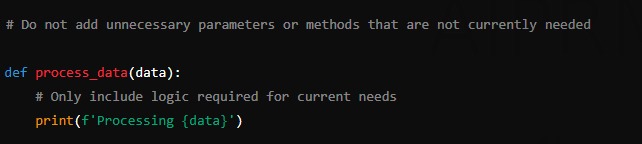
8. You Are not Gon na Need It( YAGNI)

The YAGNI Principle is a mantra of extreme programming that stands for” You Are not Gon na Need It.” It implies that you shouldn’t add functionality until it’s necessary. Over-engineering and unseasonable optimization should be avoided.

Benefits of YAGNI

Reduced Waste : Prevents the addition of gratuitous features. concentrated Development Encourages working on features that deliver immediate value.

Simplified Codebase: Keeps the codebase spare and manageable. illustration

Example

Conclusion

Adhering to solid software design principles is essential for developing robust, scalable, and maintainable software. Principles like SRP, OCP, LSP, ISP, DIP, DRY, KISS, YAGNI, and Composition Over Inheritance provide a framework that guides developers in creating high-quality software systems. By understanding and implementing these principles, development teams can significantly enhance the efficiency and effectiveness of their software development processes.

Stimulus Update: What You Need to Know

Stimulus Update: What You Need to Know

In today’s ever-changing economic landscape, staying informed about government stimulus packages is crucial. The topic of “stimulus update” has been on the minds of many individuals and businesses alike. In this comprehensive guide, we will break down the latest stimulus updates, including who qualifies, how to apply, and what to expect. Let’s dive in and ensure you are up to date on this vital financial support

Understanding Stimulus Packages

What Are Stimulus Packages?

Stimulus packages are financial aids provided by the government to stimulate economic growth during times of crisis. These packages typically include direct payments to individuals and financial support for businesses.

Historical Perspective

Stimulus packages have been used throughout history to combat economic downturns. Notable examples include the New Deal during the Great Depression and the stimulus packages following the 2008 financial crisis.

The Current Situation

COVID-19 Relief Stimulus

The COVID-19 pandemic brought about an urgent need for stimulus support. Various relief packages were passed to provide financial assistance to individuals and businesses affected by the pandemic.

Economic Impact Payments

Economic Impact Payments, also known as stimulus checks, were a key component of COVID-19 relief. These direct payments aimed to provide financial relief to individuals and families.

Eligibility Criteria

Individuals

Eligibility for stimulus payments typically depends on factors such as income, marital status, and the number of dependents. Income thresholds may vary based on the specific stimulus package.

Small Businesses

Small businesses may also be eligible for stimulus support. Requirements and application processes differ, so it’s essential to stay informed about the latest updates.

Application Process

Online Resources

In most cases, individuals and businesses can apply for stimulus assistance online. Government websites and portals provide user-friendly interfaces for submitting applications.

Paper Applications

For those without internet access or in special circumstances, paper applications are often available. These can be requested and submitted by mail.

Disbursement Methods

Direct Deposits

Direct deposits are the fastest way to receive stimulus payments. The funds are electronically transferred into the recipient’s bank account.

Checks and Debit Cards

Some individuals may receive paper checks or prepaid debit cards in the mail as an alternative disbursement method.

Tax Implications

Tax Credits

Stimulus payments are typically not taxable income. However, they may affect certain tax credits, so it’s important to understand their implications on your tax return.

Reporting Stimulus Payments

You may need to report the receipt of stimulus payments on your tax return, even though they are not taxable income. Failing to do so could lead to issues with your tax filings.

Frequently Asked Questions (FAQs)

Who is eligible for the latest stimulus package?

Eligibility criteria can vary, but it often includes individuals with certain income levels, families, and small businesses facing financial hardships.

How do I apply for stimulus assistance?

Visit the official government website or consult your tax advisor for guidance on applying for stimulus assistance.

What are the tax implications of stimulus payments?

While stimulus payments themselves are not taxable, they may impact other tax credits and deductions.

Are small businesses eligible for stimulus support?

Yes, many stimulus packages include provisions to support small businesses during economic challenges.

Where can I find more information on stimulus updates?

For the most up-to-date information on stimulus updates and eligibility criteria, visit the official government websites or consult with financial advisors.

In conclusion, staying informed about stimulus updates is crucial in today’s economic climate. Whether you are an individual in need of financial assistance or a small business owner seeking support, understanding the latest developments in stimulus packages can make a significant difference. Remember to keep an eye on official government sources for the most accurate and up-to-date information.

FAQs

  1. Is there a deadline for applying for stimulus assistance?
    • Deadlines may vary depending on the specific stimulus package. Check the official government website for the latest information.
  2. Can non-citizens or residents apply for stimulus payments?
    • Eligibility criteria often include citizenship or residency requirements. Refer to official government sources for precise details.
  3. How will I know if I qualify for a stimulus payment?
    • Eligibility criteria are typically outlined in the stimulus package’s official documentation. Consult the relevant government website or seek professional advice for clarification.
  4. What should I do if I haven’t received my stimulus payment yet?
    • If you believe you are eligible and haven’t received your payment, contact the IRS or relevant government agency for assistance.
  5. Are there any scams related to stimulus payments I should be aware of?
    • Yes, there have been reports of stimulus payment scams. Always verify the authenticity of communications and websites and be cautious about sharing personal information.