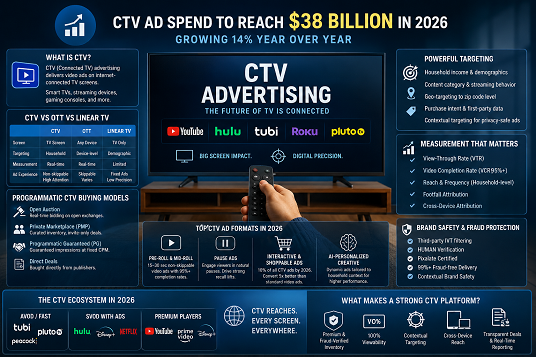
CTV ad spend is projected to reach $38 billion in 2026, growing 14% year over year. Linear TV budgets are shifting fast. Brands and media planners that understand connected TV advertising today will hold a clear screen advantage for the rest of this decade.
What Is CTV Advertising?
The Simple Definition
CTV stands for Connected TV. CTV advertising means delivering video ads on television screens that connect to the internet. These screens include smart TVs with built-in streaming apps, Amazon Fire TV Sticks, Roku players, Apple TV, Chromecast, and gaming consoles like PlayStation and Xbox.
CTV ads run during streaming content on platforms like YouTube TV, Peacock, Tubi, Pluto TV, and ad-supported tiers of major streaming services. Unlike traditional cable TV, CTV is fully digital. Every impression is measurable, and every campaign is targetable at the household level.
CTV vs OTT vs Linear TV: The Difference That Matters
Many media planners use these three terms interchangeably. They are not the same.
OTT (Over-the-Top) refers to any video content delivered over the internet, bypassing traditional cable or satellite. OTT content reaches audiences on any device: phone, laptop, tablet, or TV screen.
CTV is a subset of OTT. CTV refers specifically to OTT content viewed on a television screen, whether through a smart TV or a connected streaming device.
Linear TV is traditional broadcast or cable television. Ads run at fixed time slots, targeting broad demographic groups with no real-time measurement or campaign optimization.
| Feature | CTV | OTT |
| Screen Type | TV screen only | Any device (TV, phone, tablet) |
| Targeting | Household-level, contextual | Device-level, behavioral |
| Measurement | Real-time, cross-device | Real-time, device-based |
| Ad Format | Non-skippable video, pause ads | Pre-roll, mid-roll, display overlays |
| vs Linear TV | Digital precision on big screen | Broader reach, any screen |
The practical difference for advertisers: CTV combines the big-screen impact of traditional TV with the precision targeting and measurability of digital. Linear TV offers neither.
How CTV Advertising Works: Step by Step
How Ads Get Delivered on Streaming Screens
The CTV ad delivery chain moves fast and involves several layers. Understanding it helps media planners make smarter buying decisions.
An advertiser sets up a campaign through a DSP (Demand-Side Platform). The DSP sends bid requests across multiple SSPs (Supply-Side Platforms), which aggregate inventory from streaming publishers. When a viewer starts watching content, the streaming platform uses SSAI (Server-Side Ad Insertion) to stitch the ad seamlessly into the video stream. The ad plays on the TV screen, and the impression is recorded in real time.
This entire process happens in milliseconds. The result is a TV-quality ad experience with digital-level measurement and attribution.
Programmatic CTV Buying Models Explained
Most competitor articles list these terms without explaining them. Here is what each model means for media planners in practice:
Open Auction: Advertisers bid in real time across open exchanges. Inventory is widely available. CPMs are competitive, but brand safety controls are lighter than in premium environments.
Private Marketplace (PMP): A curated deal between a publisher and selected advertisers. Inventory is premium and pre-negotiated, with stronger brand safety parameters than open auctions.
Programmatic Guaranteed (PG): The closest programmatic equivalent to a traditional TV direct buy. The advertiser and publisher agree on a fixed CPM and a reserved volume of impressions in advance. This is the preferred model for high-stakes campaigns, product launches, and seasonal pushes where guaranteed delivery matters.
Direct Deals: Inventory purchased directly from a streaming publisher outside of programmatic infrastructure. Offers the highest editorial control but the least operational flexibility.
In 2026, PMP and PG deals are the preferred choice for premium advertisers because they combine the automation of programmatic with the quality controls of direct buying.
CTV Ad Formats Brands Use in 2026
Pre-roll and mid-roll video spots (15 to 30 seconds) remain the dominant format and regularly achieve completion rates above 95% on streaming platforms.
Pause ads appear when a viewer pauses content, placing a brand message in a natural, uninterrupted moment. These ads deliver strong unaided recall lifts without disrupting the viewing experience.
Interactive and shoppable CTV ads are the fastest-growing format. According to Demand Local, by 2026, interactive shoppable ads are projected to represent 10% of all CTV ads, and CTV shoppable ads convert 5x better than standard video ads. QR codes embedded in CTV ads tripled year over year, bridging the gap between the TV screen and mobile purchase.
AI-personalized dynamic creative is moving from experimental to essential. Campaigns that tailor the ad message based on household context, content category, or time of day consistently outperform static one-size creatives.
CTV Targeting Capabilities: Why It Beats Traditional TV
Household-Level and Contextual Targeting
Traditional linear TV targeting stops at broad age and gender demographics, the classic model of women 18 to 49 or men 25 to 54. CTV targeting operates at a fundamentally different level.
CTV platforms allow advertisers to target by household income, content category, streaming behavior, device type, geographic location down to the zip code level, purchase intent signals, and first-party audience data. A brand running a luxury auto campaign targets households with relevant income profiles watching automotive or lifestyle content, rather than paying to reach every viewer of a broadcast primetime slot.
Contextual targeting adds another layer. Ads appear adjacent to content that matches the brand’s category, increasing relevance without relying on personal data and keeping campaigns privacy-compliant as third-party cookie deprecation continues.
For a deeper look at how contextual targeting works in programmatic environments, the Xapads blog covers the principles and practical applications in detail.
Cross-Device Targeting: CTV Plus Mobile
CTV does not operate in isolation. The most effective campaigns in 2026 treat CTV as the awareness layer of a broader digital strategy.
Research from Paramount Ads shows that paid social conversion rates improve by 8.5% when audiences have previously seen a brand on streaming TV. And 51% of heavy CTV viewers search online after seeing something on TV.
Advertisers that connect CTV targeting with mobile retargeting activate a sequential messaging strategy: brand awareness on the big screen, followed by a performance-focused mobile touchpoint that converts the same household.
CTV Measurement and Brand Safety in 2026
How Brands Measure CTV Campaign Performance
CTV offers measurement capabilities that linear TV never could. The key metrics advertisers track include view-through rate (VTR), video completion rate (VCR), reach and frequency at the household level, footfall attribution (tracking whether a CTV-exposed household later visited a physical location), and cross-device attribution that maps the full path from TV impression to conversion.
Standard pre-roll and mid-roll ads on streaming platforms regularly achieve completion rates above 95%, driven by the non-skippable nature of most CTV inventory. This makes CTV one of the highest-attention advertising formats available, significantly ahead of display, social video, and most mobile formats.
Brand Safety and Fraud Prevention: What to Look For
This section is what most competitor articles skip entirely, and it represents one of the most important evaluation criteria for media planners.
CTV ad fraud takes multiple forms: device spoofing (a bot imitates a connected TV), app spoofing (a low-quality app falsely claims to be a premium streaming app), and SSAI stitching fraud (ads are injected into streams that no real viewer ever watches). Without fraud verification, a meaningful portion of CTV impressions can be wasted on invalid traffic.
Media planners evaluating CTV platforms should look for third-party fraud verification through recognized providers. IVT (Invalid Traffic) filtering, HUMAN verification, Pixalate certification, and 99%+ fraud-free delivery standards are the baseline markers of a trustworthy CTV buying environment. Contextual brand safety tools also matter: ads should not appear next to content that conflicts with a brand’s guidelines, regardless of how programmatically efficient the inventory appears on paper.
Which Platforms Power CTV Advertising in 2026?
Major Streaming Inventory Sources
The CTV inventory market is concentrated at the top. According to Adwave’s 2026 CTV Market Forecast, YouTube commands nearly 12% of all CTV ad revenues. Amazon through Prime Video, Fire TV, and Freevee captures over 10%. Disney through Hulu, Disney+, and ESPN holds over 10%. Netflix is the fastest-growing major platform, with ad revenue expected to more than double from its 2025 base.
The Hulu and Disney+ integration in 2026 creates a combined ad-supported streaming audience with significant scale, simplifying planning for advertisers who previously managed both services separately.
Beyond the top tier, FAST platforms including Tubi, Pluto TV, Peacock free tier, and Rakuten TV serve a large share of ad-supported viewing hours. These platforms typically offer broader reach at lower CPMs, making them attractive for campaigns that prioritize scale over editorial prestige.
AVOD, FAST, and SVOD: The Three Models Brands Buy Across
AVOD (Ad-Supported Video on Demand): Platforms offering free content in exchange for ad viewing. Tubi, Peacock, and Pluto TV operate on this model. Advertisers reach audiences who actively chose free, ad-supported access.
FAST (Free Ad-Supported Streaming TV): Linear-style streaming channels with continuous programming and ad breaks similar to traditional TV. FAST channel audiences have grown 55% year over year. The viewing experience closely resembles cable TV, which makes FAST attractive for linear TV budget transitions.
SVOD with ads (Subscription Video on Demand with an ad tier): Platforms like Netflix, Disney+, and Max now offer lower-cost subscription tiers with limited advertising. These audiences tend to have higher household incomes and stronger purchase intent, making them particularly valuable for premium brand campaigns.
Understanding the monetization model behind each platform helps media planners set realistic CPM expectations and audience quality benchmarks before allocating budget.
DSPs and CTV Ad-Buying Platforms
A DSP (Demand-Side Platform) for CTV allows advertisers to buy inventory programmatically across multiple streaming publishers from a single interface. Rather than negotiating separate direct deals with each streaming service, a DSP aggregates inventory from hundreds of publishers through integrated SSPs, applies audience targeting, and optimizes bids in real time.
For brands and agencies running multi-market or global CTV campaigns, the choice of DSP determines the quality of available inventory, the reliability of fraud filtering, the depth of targeting options, and the accuracy of measurement and attribution reporting.
What Makes a Strong CTV Platform for Brands and Media Planners?
Not all CTV platforms operate at the same standard. Media planners should evaluate any CTV buying platform against these criteria before committing campaign budget: premium and fraud-verified inventory with third-party IVT filtering, high viewability guarantees across all placements, strong view-through rates driven by non-skippable ad formats, contextual targeting at the content level, cross-device reach that connects CTV audiences with mobile retargeting, global inventory access for multi-market campaigns, and transparent deal structures including PMP and PG options with real-time reporting.
Unwire, a dedicated programmatic CTV platform, meets these benchmarks with 120M+ global reach, 100% viewability across premium channels, 85%+ view-through rate through non-blockable video ad formats, 99%+ fraud-free delivery verified by HUMAN and Pixalate, approximately 10 contextual ad placements per minute, OTT header bidding, and a Smart Media Planner that enables transparent PMP and PG deal execution with real-time campaign reporting.
For brands running a full-funnel strategy, Unwire operates as the awareness layer within the Xapads ecosystem, building premium CTV reach that feeds into consideration and conversion stages across complementary channels.
Key Takeaways for Brands and Media Planners
CTV is now the default screen for video audiences. Streaming surpassed linear TV viewing time in 2026, and that gap will continue to widen through the decade.
Programmatic buying makes CTV accessible at any scale. PMP and PG deals give premium advertisers brand-safe access to curated inventory without the inefficiency of open-auction CPM waste.
Measurement, brand safety, and fraud protection matter as much as reach. Media planners should treat fraud verification and viewability guarantees as non-negotiable criteria when evaluating any CTV platform.
The right CTV platform combines premium inventory, contextual targeting, cross-device attribution, and transparent deal structures. These four capabilities determine whether CTV spend delivers measurable brand outcomes or simply reaches a large but unmeasured audience. CTV advertising is not a future trend. It is the operational reality of 2026. Brands and media planners that understand how it works, which platforms to trust, and how to measure it correctly will run campaigns that perform from the first impression through the last conversion.